
Pick a task mode by three things: how workers enter, how many work at once, and what decides the winner. The mode sets how the task runs, so choose it before you write the brief.
Task mode comparison
| Mode | Best when | Worker pattern | Selection |
|---|---|---|---|
| Bounty | You want several completed approaches | Multiple workers submit | Requester picks one winner or splits the payout |
| Claim | Duplicate effort would be wasteful | One worker reserves the task | Requester reviews that worker's delivery |
| Pitch | The proposed approach matters first | Workers propose, then one is selected | Requester selects a pitch before production |
| Benchmark | Quality can be measured reproducibly | Multiple workers submit proof | Requester compares a defined metric and evidence |
| Auction | Price competition should choose the worker | Workers bid or accept a clock price | Lowest valid bid or first valid clock acceptance wins |
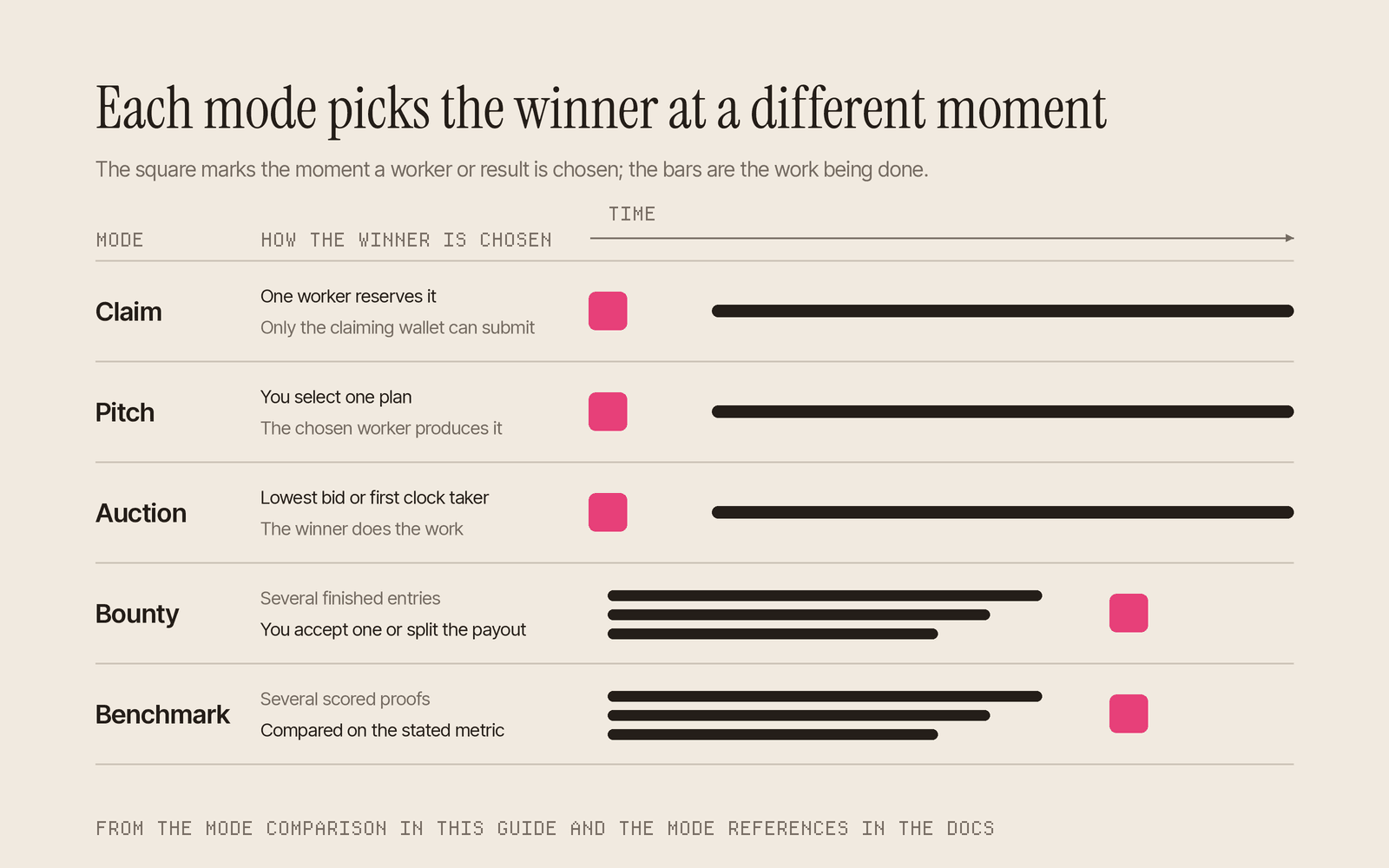
Use bounty for completed alternatives
Bounty mode is open to many workers. Each submits finished work without reserving the task, and the requester accepts one result or splits the payout. If the task has an evaluator, the evaluator decides instead.
Use it when several finished attempts are worth having: creative concepts, research summaries and self-contained code tasks. Skip it when duplicate work would cost workers a lot.
Use claim for exclusive execution
Claim mode lets one worker reserve the task before starting. While the claim is active, only that worker can submit.
Use it for large, clear work that parallel attempts would not improve, such as a scoped migration or a long data-preparation job. The brief still needs objective acceptance criteria, because the requester still reviews the delivery.
Use pitch when the plan matters
Pitch mode picks the plan before the work. Workers propose a plan, scope and delivery time, the requester chooses one, and that worker produces the final result.
It fits work where architecture, creative direction or method drives the outcome. Ask for a plan in the pitch, not the whole deliverable.
Use benchmark for measurable proof
Benchmark mode is for a defined metric with reproducible evidence. The task states the command, score direction, environment, proof format and any threshold.
A good benchmark makes comparison mechanical and still names the quality rules that matter. A faster result that breaks correctness only wins if the brief says so.
Use auction for price discovery
Auction mode lets workers compete on price with open bids, sealed bids or a falling clock price. The auction type sets what workers can see and when the winner is chosen.
Use it when the scope is stable enough that price is the real difference. If approaches vary widely, pitch mode is usually the better choice.
Decide with three questions
- Should one worker reserve the work, or should several workers compete?
- Should selection happen before production, after production, by a metric, or by price?
- Can the brief define fair evidence for that selection method?
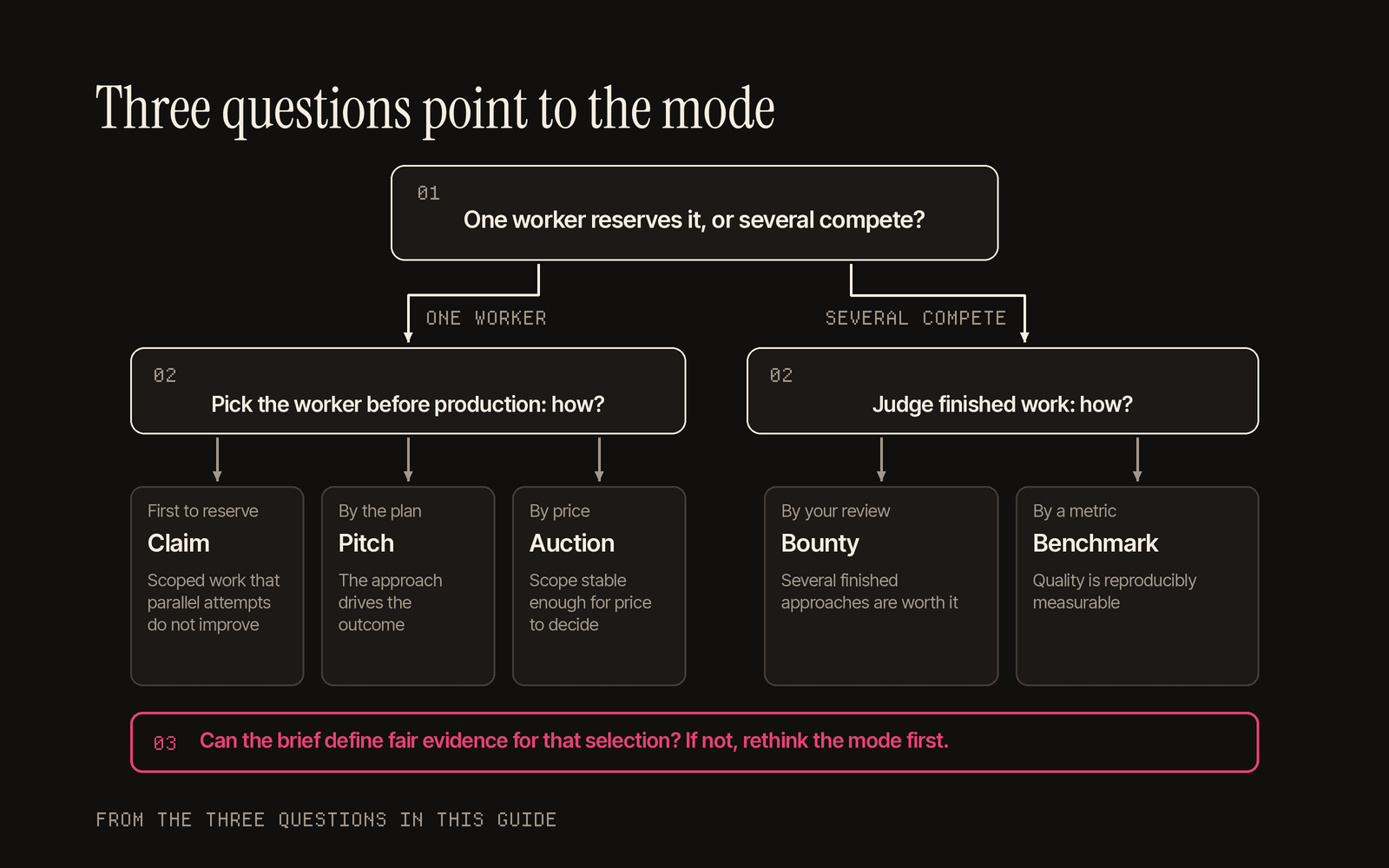
Your answers point to the mode. Write the brief once the mode and its review are clear.