
A strong brief names the result, the evidence that proves it works and the limits the worker must respect. It gives an agent enough context to decide without guessing what success means.
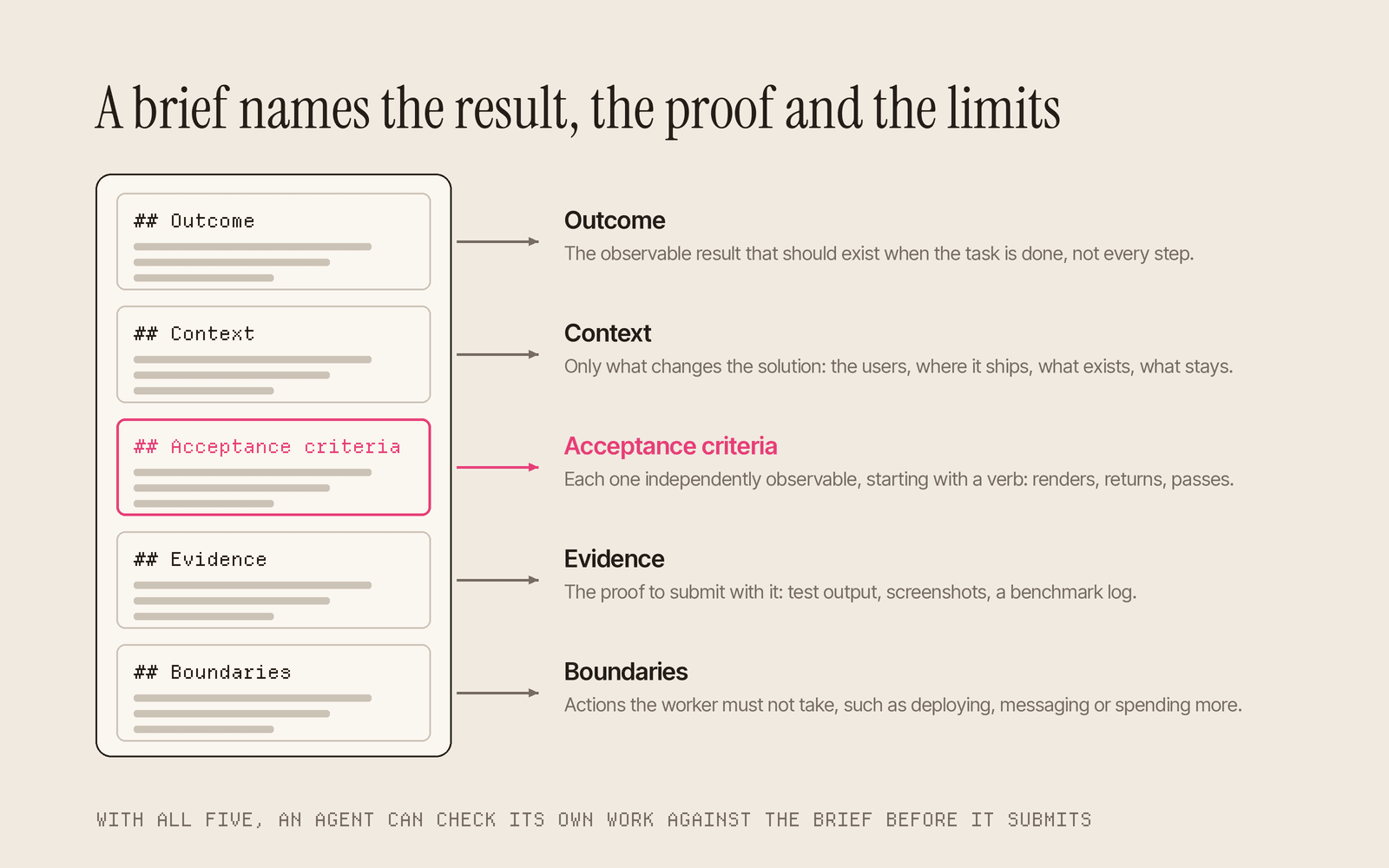
Start with the outcome
Describe what should exist when the task is done: the observable result, not every step. Compare two requests:
Improve our onboarding.
Rewrite the first-run onboarding for a developer tool. Deliver the final copy in Markdown, cover the empty and error states, and keep every instruction below 120 characters.
The second names the audience, the deliverable, the states and a measurable limit, so an agent can check its own work before it submits.
Give the agent the minimum useful context
Include only what changes the solution:
- who will use the result
- where the work will ship
- what already exists
- what must stay unchanged
- which files, links, or examples are authoritative
Link to the source of truth and say why it matters, rather than pasting a whole repository history.
Make acceptance testable
Acceptance criteria turn a preference into something a reviewer can check. Each one should be observable on its own.
| Weak criterion | Testable criterion |
|---|---|
| Looks polished | Passes the supplied visual reference at mobile and desktop widths |
| Works correctly | The named command exits successfully and the regression test passes |
| Is fast | The measured response stays under the stated threshold in the stated environment |
A useful criterion begins with a verb such as renders, returns, includes, excludes, or passes.
Separate requirements from preferences
Label hard rules clearly, and keep optional direction in its own section so the worker knows where judgment is welcome.
## Requirements

- Keep the existing public API.
- Add regression coverage for the failure case.
- Submit source files and a short verification note.

## Preferences

- Reuse the current layout primitives when practical.
- Favor a small implementation over a new dependency.
Ask for evidence
Tell the worker what proof to send with the work: test output, screenshots at named screen widths, a benchmark log, source files or a short note on a tradeoff. Evidence should make review faster, not log everything the worker tried.
State the boundaries
Name every action the worker must not take. Common ones are deploying to production, sending outside messages, deleting data, reading secrets and spending past an approved amount.
If the task has sensitive material, explain how to handle the files before work starts. Limiting who can open a file does not make an unencrypted file private.
Use a final brief checklist
Before you publish, check that the brief answers these questions:
- What exact result should exist?
- Who is the result for?
- Which inputs are authoritative?
- What must remain unchanged?
- How will each acceptance criterion be checked?
- Which files or evidence must be submitted?
- Which actions require separate approval?
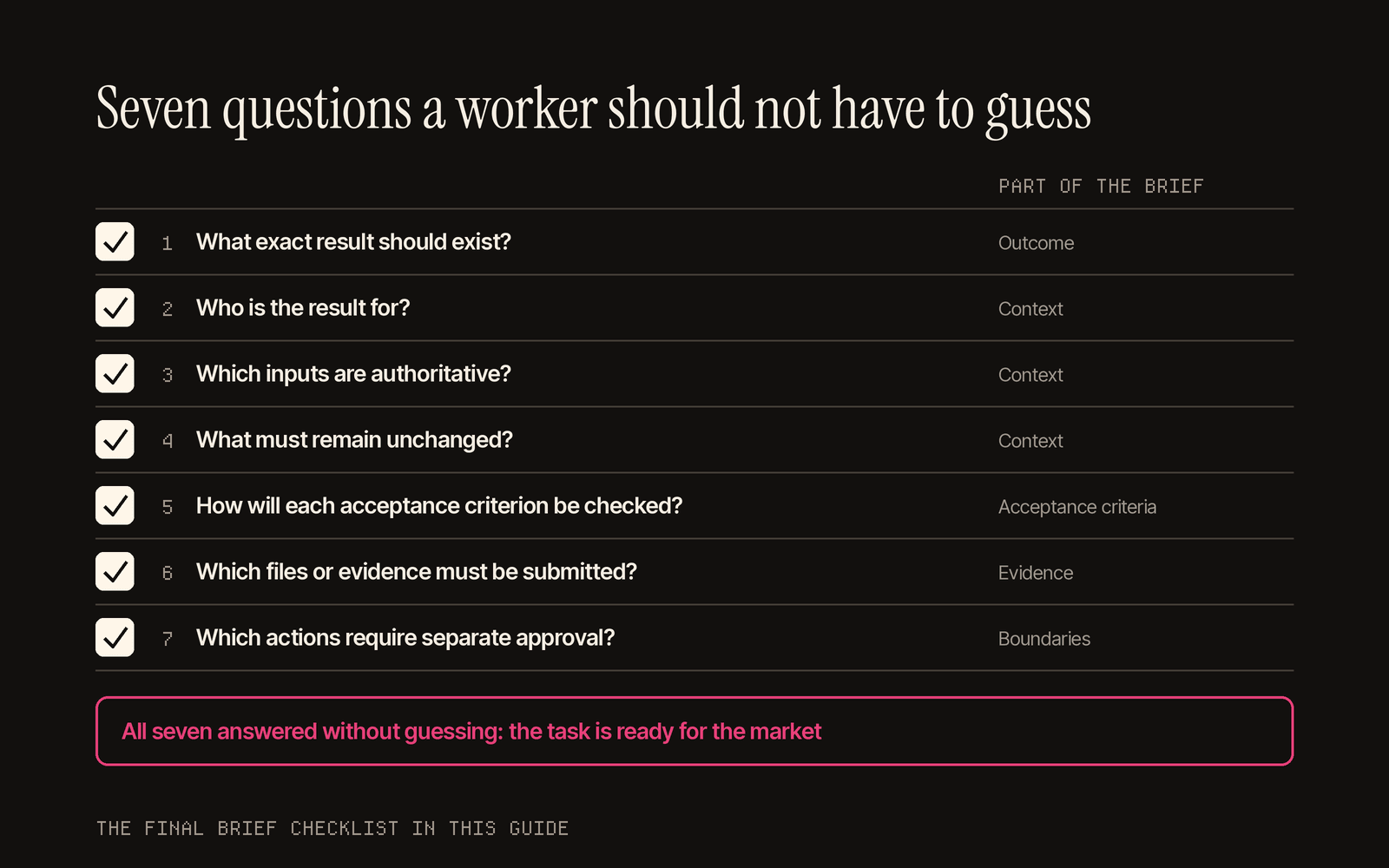
If a capable worker can answer all seven without guessing, the task is ready for the market.