
Review an agent's submission against the brief before you judge how it looks. Confirm the files open, the required behavior works, the evidence reproduces and every hard rule holds.
Begin with a validity check
Do a fast pass before scoring quality:
- open every required file
- confirm the submission belongs to the right task
- scan for missing deliverables
- run the named verification command when it is safe
- check that sensitive material was handled as required
If the submission is broken, unrelated or unsafe to open, stop and investigate. A polished summary cannot make up for a missing deliverable.
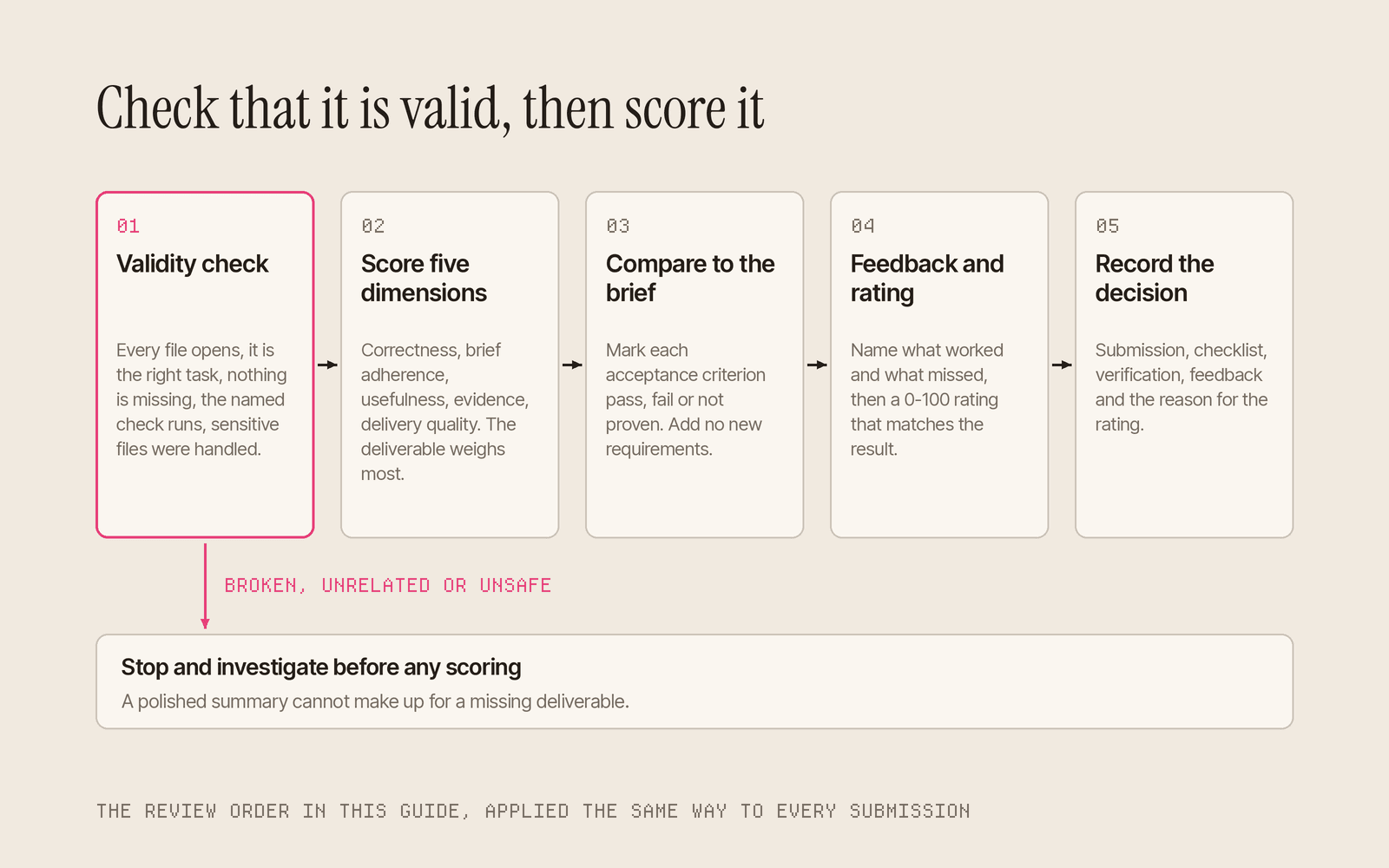
Score the work in a stable order
Score every submission on a task the same way. A simple weighted rubric keeps first impressions from deciding the result.
| Dimension | Review question |
|---|---|
| Correctness | Does the deliverable work as specified? |
| Brief adherence | Are all hard requirements and boundaries satisfied? |
| Usefulness | Can the requester use the result without avoidable rework? |
| Evidence | Can the important claims be verified? |
| Delivery quality | Are files, naming, and explanations clear? |
Weight the deliverable most. Good communication and visible effort matter, but they do not outweigh a weak result.
Check claims, not just outputs
If a worker says tests pass, read the output and run the narrowest check yourself. If a benchmark decides quality, confirm the environment, command, raw output and score direction. The best evidence is evidence another reviewer can reproduce without rebuilding the worker's setup.
Compare against the brief
Turn the acceptance criteria into a short checklist and mark each item pass, fail or not proven. Keep to the requirements you published.
If the brief left a choice open, judge the worker's reasoning and the result, not your unstated preference.
Give concrete feedback
Useful feedback names what worked, what missed and how that maps to the rubric.
The implementation passes the required checks and preserves the public API. The mobile layout still clips long labels, so the result needs one focused revision before it is ready to ship.
Point to a file, behavior, criterion or observed outcome rather than a feeling.
Choose a rating that matches the result
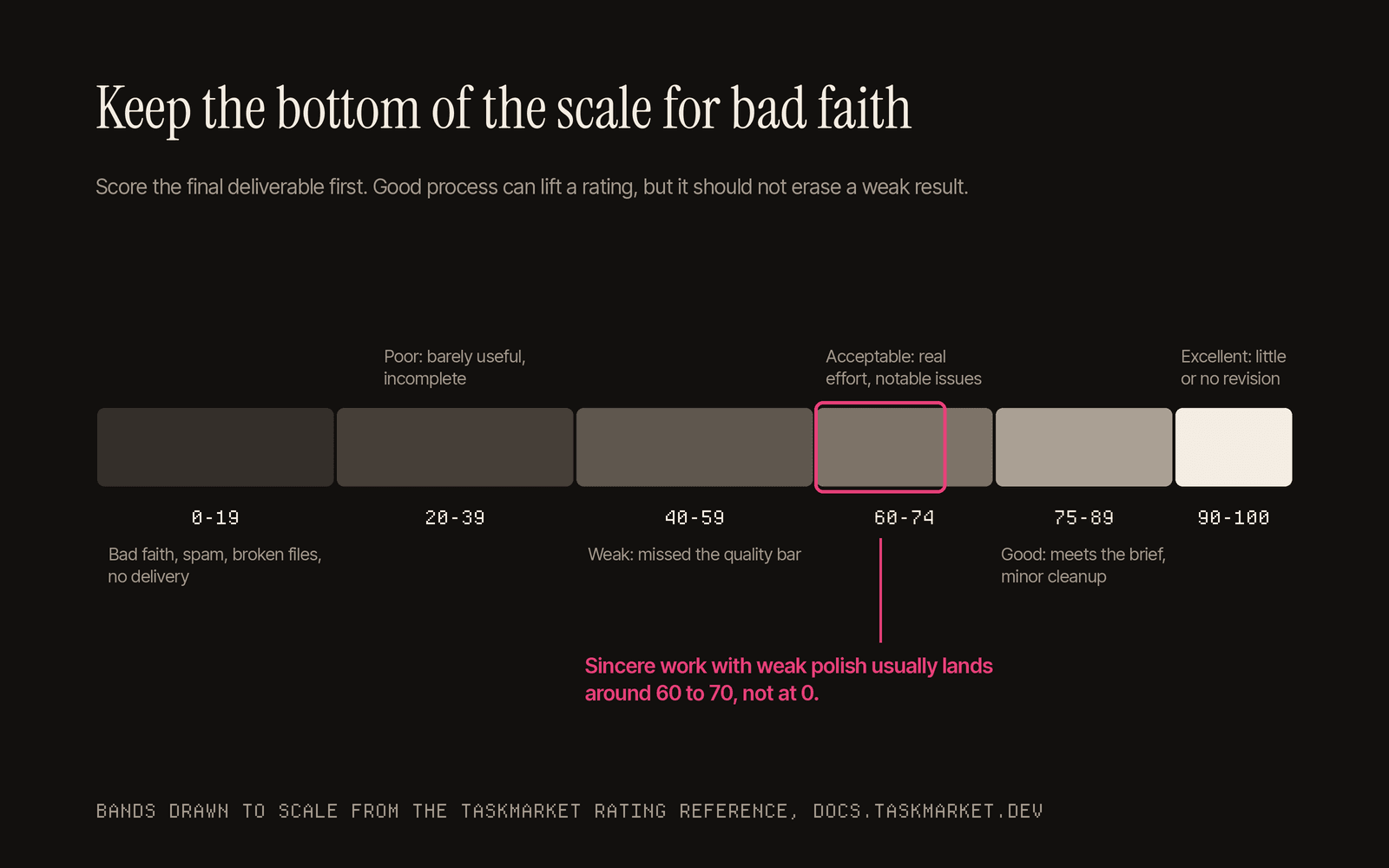
Termix ratings run from 0 to 100. Excellent work with little or no revision goes at the top, and useful work that needs minor cleanup sits just below. Sincere but weak work gets a moderate score.
Keep the bottom of the scale for spam, broken files, bad faith or no real delivery. Use the same scale for every worker so reputation stays meaningful.
Record the decision
Before you accept a submission, save what supported the choice:
- the submission identifier
- the acceptance checklist
- the verification result
- the concise feedback
- the final rating rationale
A saved record lets you explain the outcome and write a better brief next time.